⚡ Quick Key Takeaways
This guide provides independently verified gameplay mechanics, mathematical return profiles, mobile setup instructions, and official banking steps for Philippine players. All data adheres to PAGCOR standards.

Tongits is the undisputed king of Philippine card games. Originating in Pangasinan and Northern Luzon during the 1990s, this three-player rummy derivative quickly spread across barangay street corners, family gatherings, and recreational halls throughout the archipelago. Unlike slot machines that rely purely on chance, Tongits is a game of skill, psychological maneuvering, tactical card arrangement, and strict timing.
On WINPH, the authentic Pinoy card experience has been elevated into a seamless digital arena. Filipino players can challenge active real-money opponents or compete in fast-paced automated tables anytime, anywhere. In this comprehensive guide, we cover card values, structural melds, combat calls (Fight, Draw, and Challenger rules), the intricacies of sapaw, and defensive discarding strategies to help you master the table.
The Origin and Essence of Filipino Tongits
Tongits is played with a standard 52-card international deck without jokers, designed specifically for exactly three players. It shares mechanical similarities with classic Gin Rummy, Mahjong, and the Cantonese card game Ton-Gits, but introduces distinct Philippine tactical conventions that reward sharp memory and calculated aggression:
- ◆Three-Player Intensity: Unlike four-player card games where partners or larger tables dilute card tracking, three players ensure high card turnover and immediate accountability. Every discard you release directly impacts the player to your right.
Deck Composition, Card Points, and Valid Melds
Mastering Tongits begins with memorizing card point values and learning to quickly group raw dealt hands into valid scoring sets (bahay):
Card Point Values (Deadwood Count)
When calculating remaining unmelded cards at the conclusion of a round, points are assigned as follows:- ◆Aces: 1 Point each.
- ◆Numbered Cards (2 through 9): Face value (e.g., 5 is worth 5 points, 8 is worth 8 points).
- ◆Face Cards (10, Jack, Queen, King): 10 Points each.
Valid Combinations (Melds / Bahay)
A valid combination must consist of at least three cards arranged in one of two formats: Trio (Three of a Kind): Three cards of identical rank across different suits (e.g., 7 of Spades, 7 of Hearts, 7 of Diamonds). A four-of-a-kind combination (Quad*) can also be laid down together.- ◆Escalera (Straight Flush / Sequence): Three or more consecutive cards in the exact same suit (e.g., 4, 5, and 6 of Clubs, or 9, 10, Jack, Queen of Hearts). Note that Aces are strictly low in standard rules (A-2-3 is valid, but Q-K-A is not allowed).
Complete Turn Progression and Table Flow
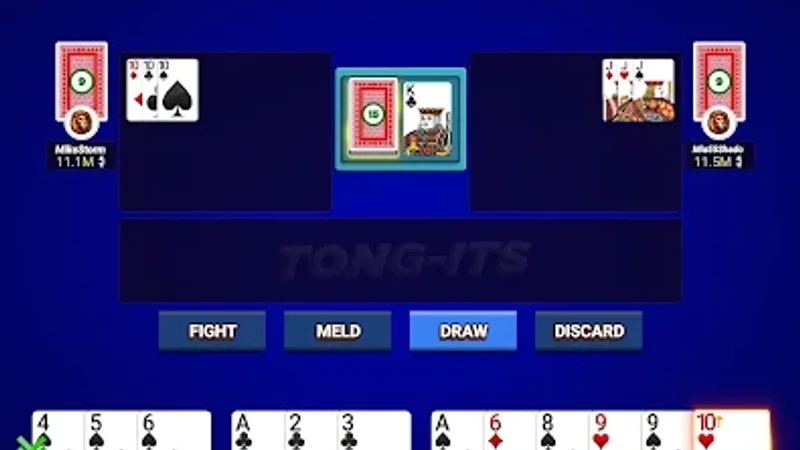
A standard round on WINPH proceeds systematically in a clockwise direction:
The Initial Deal
- ◆The dealer receives 13 cards.
- ◆The remaining two players receive 12 cards each.
- ◆Because the dealer holds 13 cards, they do not draw on turn one; their opening action is simply to discard one unwanted card to ignite the discard pile.
The Standard Turn Cycle
On every subsequent turn, a player executes four sequential steps:
1. Draw or Pick Up: The player either draws the top unknown card from the central stock pile OR picks up the topmost face-up card from the discard pile. Crucially, you can only pick up from the discard pile if that specific card immediately forms a valid meld with cards already in your hand.
2. Expose Melds (Optional / Strategic): The player may lay down any completed trios or escaleras face-up onto their personal playing zone. You must open at least one meld during the game to avoid being sunog.
3. Sapaw (Laying Off): If you already have an opened meld on the table, you may attach matching cards from your hand onto your own opened melds or onto any opened melds belonging to opponents.
4. Discard: To conclude the turn, the player must place exactly one card face-up onto the discard pile.
Deciphering Key Actions: Tongits, Fight, and Draw
The psychological depth of Tongits manifests when players decide how and when to end a round:
Calling Tongits (Natural Victory)
If a player successfully melds and lays off every single card in their hand, leaving zero cards remaining without needing a final discard, they declare Tongits. This triggers an immediate, uncontested round victory and earns maximum bonus payouts from both opponents.Calling a Fight / Draw
If you believe that the total point value of your unmelded cards is lower than your opponents', and no player has picked up your discards since your last turn, you may declare a Fight (often called Draw in local dialect) at the start of your turn instead of drawing a new card: Eligibility Requirement: You must have opened at least one meld on the table, and nobody must have laid off (sapaw*) onto your exposed cards during the preceding circuit.- ◆The Fold Decision: When you call a Fight, opponents have two choices:
Deck Depletion (End of Stock)
If the central stock deck runs completely out of cards before any player declares Tongits or calls a Fight, all players must reveal their remaining hand cards. The player with the lowest total deadwood points wins the pot, provided they have opened at least one meld during the match.Advanced Strategy: The Art of Sapaw and Hand Concealment
Top-tier Tongits competitors distinguish themselves through disciplined tactical restraint:
- ◆Holding Hidden Melds: Inexperienced players often expose every completed meld immediately. Doing so reveals your hand structure and allows opponents to safely deduce which suits are safe to discard. By keeping completed bahay concealed in your hand until mid-game, you maintain tactical mystery and prevent opponents from reading your intentions.
- ◆Card Counting and Discard Memorization: In a 52-card deck with only three players, tracking which high cards (Jacks, Queens, Kings) have been discarded allows you to deduce which straights your opponents are building. Never discard a card that directly connects to an opponent's exposed meld unless completely unavoidable.
Seamless Tongits Action on WINPH Mobile
Playing Tongits online through WINPH provides distinct advantages over casual backyard games:
- ◆Automated Score Tabulation: The system calculates deadwood totals, valid melds, and sapaw opportunities instantaneously, eliminating human calculation disputes or misdeals.
- ◆Fair Matchmaking & Anti-Collusion: WINPH enforces strict IP and device isolation at cash tables, preventing collusive play and guaranteeing that every match is an authentic test of individual card skill.
- ◆Instant Cashier Transactions: Enter ring games or tournament tables using funds deposited through GCash or Maya, and withdraw your table earnings directly to your verified wallet via the WINPH Withdrawal Guide.
- ◆Cross-Game Diversity: Once your Tongits session concludes, explore our broader Live Dealer Hub or spin top-performing reels on the Slots Hub.
Frequently Asked Questions
What happens if I am declared Sunog (Burned) in Tongits?
A player is sunog if the game ends and they failed to open at least one valid combination on the table. A burned player automatically forfeits the round, pays maximum penalty stakes to the winner, and cannot challenge any Fight call.Can an Ace be used in a high straight like Queen-King-Ace?
In traditional Philippine Tongits rules followed on WINPH, Aces are strictly low. An Ace can only be used in A-2-3 or in a trio of Aces (A-A-A). High straights like 10-J-Q-K are valid, but Q-K-A is not permitted.Can an opponent challenge my Fight call if they haven't opened a meld?
No. An opponent who has not exposed at least one valid meld (bahay) onto the table is considered closed and cannot challenge your Fight call under any circumstances; they must fold.Is Tongits on WINPH played against real human players or computer bots?
WINPH hosts dedicated multiplayer cash tables where you compete against verified, real Filipino players across the country. Certified RNG ensures completely random shuffles prior to every deal.How does the Sapaw mechanic prevent an opponent from calling a Fight?
Under standard rules, if another player attaches a card (sapaw) onto your exposed meld, you cannot call a Fight on your immediate next turn. You must draw and take a regular turn before regaining eligibility.What should I do if my internet connection drops during an active hand?
WINPH features an intelligent reconnection safeguard. If your mobile data fluctuates, the system grants a 30-second reconnection window while safely managing your turn according to basic defensive play (auto-drawing and discarding the highest unmelded card).Marco "Kuya Mac" Valenzuela
AuthorTraditional Games & Live Table Strategist
Specialist contributor for WINPH covering platform compliance, mathematical variance models, and verified Philippine payment integrations. Read more on our Author Profiles.